
Costa Rica has the most successful life sciences industry in Latin America. What very few people know is how it began—and what that origin tells us about what lies ahead.
How does a strategic sector for our economy develop? That was the question I asked myself last Thursday, June 4, during the fifth edition of CINDE’s Life Sciences Forum. Sitting in the Convention Center, surrounded by global MedTech leaders, the question transported me to a past that felt distant yet present.
It turns out that since the 1950s, Puerto Rico had built its “economic miracle” in the shadow of Section 936 of the IRS Code (the U.S. tax authority). This mechanism granted federal tax credits to U.S. corporations that set up operations on the island. By the early 1980s, the IRS was proposing to eliminate that benefit—arguing that Puerto Rico had reached a sufficient level of development and the support structure was no longer justified. At the same time, in 1983, the U.S. government launched the Caribbean Basin Initiative, aiming to promote regional economic development through free trade.
Puerto Rico responded with a brilliant move. Antonio (Tito) Colorado—one of the island’s shrewdest political operators—was appointed to head the Economic Development Administration (Puerto Rico’s equivalent of Procomer) with a clear goal: to save the industry. His proposal was to extend Puerto Rico’s development into the Caribbean and Central America through a “twin-plant” program. Companies benefiting from Section 936 would create complementary operations in neighboring countries in exchange for retaining their benefits in Puerto Rico. The United States agreed.
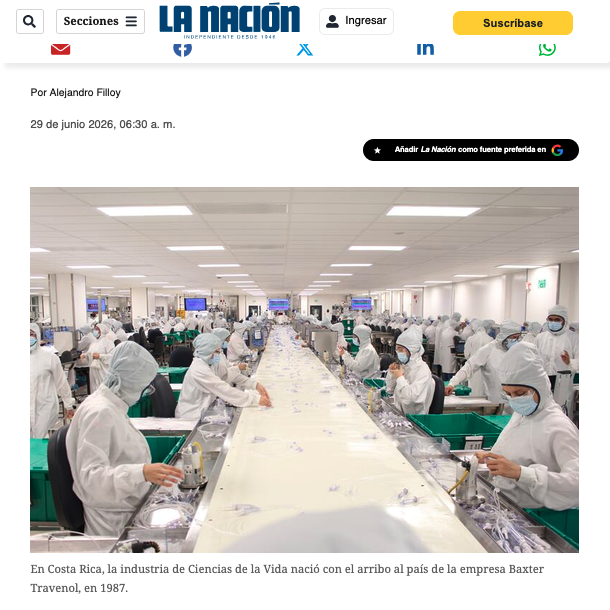
The obstacle was logistical: the Dominican Republic, due to its geographic proximity to Puerto Rico, was attracting almost all the investment. To broaden regional coverage, the development agency persuaded business leaders to evaluate other countries not just in economic terms, but based on their strategic impact in preserving Section 936. Companies divided up the region among themselves, and Costa Rica fell to Baxter Travenol. From that outcome—which was more or less accidental—Costa Rica’s life sciences industry was born. That was in 1987. Today, Costa Rica exports nearly $11 billion annually in medical devices, making it the second-largest exporter in the sector in Latin America, with fourteen of the world’s top thirty MedTech companies operating in the country. The sector employs over 54,500 people—a 216% increase in just one decade. What began as a supplementary plant for a company seeking to preserve a tax benefit evolved into the backbone of Costa Rica’s modern economy.
In 2006, Section 936 was repealed by the U.S. Congress. The impact on Puerto Rico was severe: the sector contracted by more than 30%. In Costa Rica, however, the industry continued to grow because we had built something that no longer relied on the original scaffolding: talent, a culture of quality, infrastructure, and a solid reputation.
Now, we must learn from the past to avoid repeating it. Advanced manufacturing is impressive, but the highest-value segments—R&D, clinical trials, and biotechnology—remain largely located elsewhere. The question is whether we will remain merely skilled manufacturers or become strategic partners in innovation.
Local operations also face significant challenges: talent, security, infrastructure, and operating costs—in that order of impact—are the factors that daily influence the decisions keeping these companies in the country.
In a previous article, I mentioned the urgent need to have a conversation about our next development strategy. To do so, I suggest three things: defining a shared vision of what we want to be in the next five to ten years; basing our approach on an understanding of what we have done well; and ensuring that any future we forge is inclusive—encompassing both Free Trade Zones and the definitive trade regime, as well as areas both within and outside the Greater Metropolitan Area (GAMA). It does not work if we leave entire groups out of the equation. This conversation requires the active participation and commitment of leadership across the country’s public, private, and social sectors.
In 1987, Costa Rica did not have a life sciences strategy. It had an opportunity, the will to seize it, and people on the ground—like Tito Colorado in San Juan—who helped pave the way. The result was an industry that defines the country today.
The next chapter will not come about through geopolitical accident. This time, we must build it intentionally. Thursday’s forum is a promising sign that this conversation is taking place. The question is whether, after the final panel and the last cup of coffee, that conversation will translate into a strategy.
Baxter arrived in Costa Rica almost by accident. What we built from that opportunity was anything but accidental. The next level shouldn’t be, either.
- • •
Alejandro Filloy served as Director of Customer Service for Latin America and Country Leader for Amazon Costa Rica for over a decade. He represented CINDE during the formative years of the investment promotion model that gave rise to Costa Rica’s life sciences industry. He writes about economic development, leadership, and education.
Leave a Reply