
The debate over the exchange rate focuses on a symptom; the real challenge is strategic.
A few years ago, while walking through Amazon’s facilities in Calle Blancos, I met a 28-year-old data engineer who was designing analytical tools to detect financial fraud on a global scale—working from Costa Rica for clients across three continents. That encounter stayed with me not merely as an achievement, but as a question: how much further can we go? Today, that question is more urgent than ever—yet the discussion needed to answer it is conspicuously absent. Instead, we find ourselves bogged down in a debate about the exchange rate.
Our current economic model—based on promoting exports and foreign investment—originated in the 1980s, amidst what I recall as the country’s worst economic crisis. In 1990, the Free Trade Zone Regime Law was passed, emphasizing industry and job creation as part of the solution to alleviate the crisis.
Fast-forward to 2025: total exports exceed $35 billion—an 11% increase over the previous year—and the country ranks as Latin America’s second-largest exporter of medical devices and third-largest exporter of services. It is a genuine success story, though one with its own complexities. The country has attracted so much capital and foreign currency that its own currency has strengthened beyond what traditional sectors can absorb.
Put another way: the exchange rate issue is the shadow cast by success, not failure.
The country seems trapped in the debate over the value of the colón. Is it overvalued? Who wins and who loses? We are wasting time on the wrong conversation.
The exchange rate is a symptom, not a cause. Instead of focusing entirely on exchange rate policy, it is time to launch a serious discussion about our development model.
I am not an economist; if changes to our monetary policy are required to meet the country’s macroeconomic goals, I leave that discussion to the professionals. What I do know—having managed a substantial organization within the free trade zones—is that Costa Rica has long been a high-cost location, even when the colón reached 700 to the dollar. We need to accept that much of the exchange rate effect stems from us falling victim to our own success.
This does not mean we should sit idly by. It means the right answers do not come solely from the Central Bank. They lie in a much bigger question: where is Costa Rica’s development model heading?
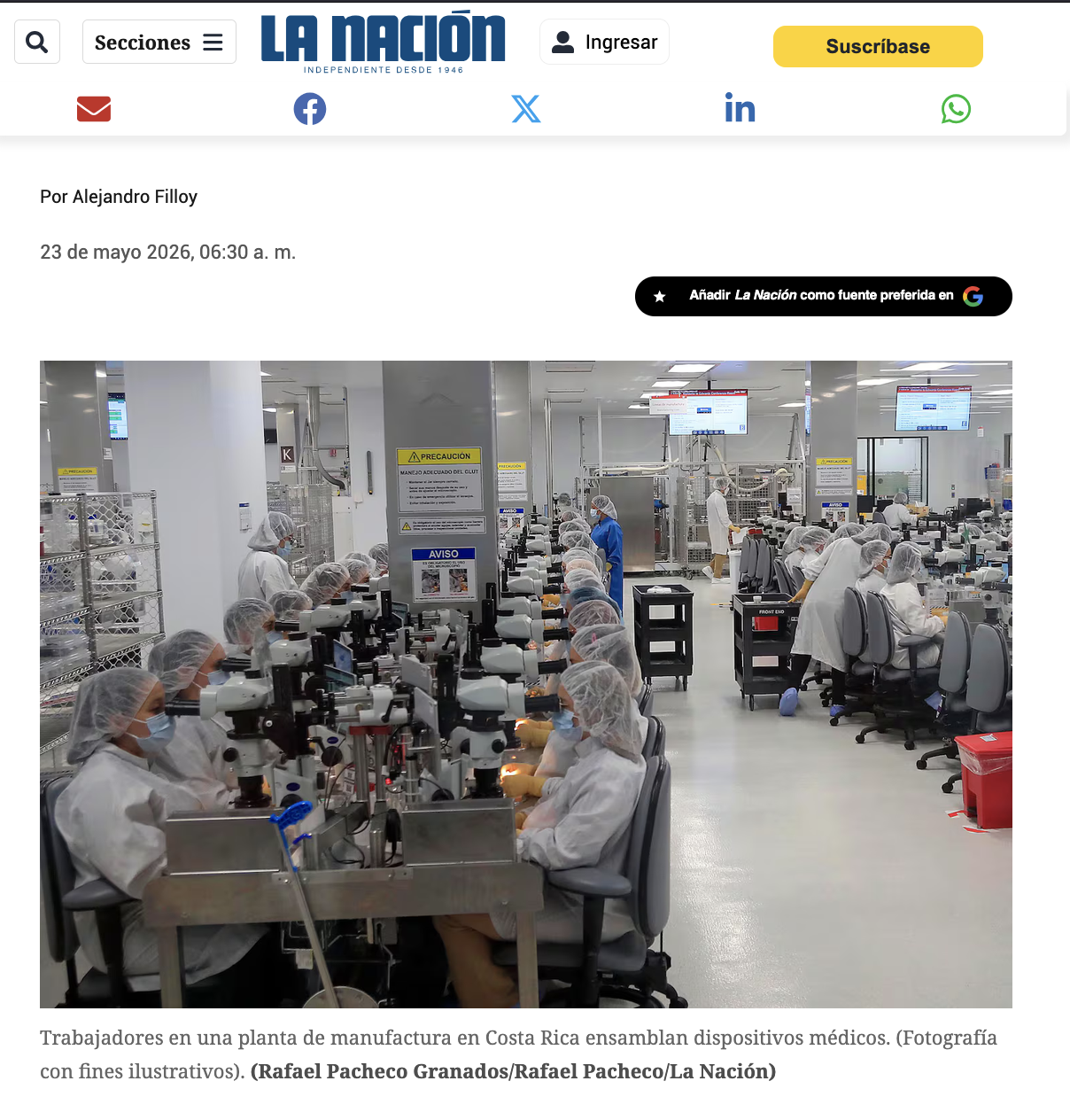
The current model has worked extraordinarily well. For four decades, the free trade zone regime and a commitment to skilled human talent transformed a small agricultural nation into a world-class hub for services and advanced industry. The results are evident: today, more than 60% of exports are high-value-added goods. Sectors such as life sciences, global corporate services, and advanced manufacturing now form the backbone of the economy.
But success has its limits.
When a country moves up to the next level—and Costa Rica has—the rules of the game change. Competitors that once exported cheap labor begin to compete on sophistication. Sectors that fail to board the value-added train get left behind.
What, then, is the conversation Costa Rica really needs to have?
In the early 1980s, we experienced the impact of a failed economic model and, amidst that national emergency, reinvented ourselves. Today, we have the luxury of being able to reinvent ourselves again before our model begins to crack. Now is the time to discuss the next step: how to scale from being an advanced manufacturing platform to becoming an innovation ecosystem; how to connect the dynamism of free trade zones with communities that do not yet participate in that growth; and how the education system can urgently produce the talent that the industries of the future—artificial intelligence, data analytics, biotechnology, cybersecurity—are already demanding.
This is the discussion that the country’s business, political, and educational leaders must have—with the same energy we devote to debating exchange rates—to devise alternatives that make us not only more competitive but also more inclusive.
I was fortunate enough to be part of a process that proved this is possible. When Amazon arrived in Costa Rica in 2008 with 500 employees, no one would have bet that a decade later we would have data engineers, transactional risk analysts, and cloud specialists managing global operations from that very same building. We moved up the value chain step by step, betting on Costa Rican talent. By the time I left the organization in 2022, there were more than 50 business units and 18,000 employees.
The question is how to turn that success into a springboard for the next version of Costa Rica.
The right exchange rate policies will help. But they will not suffice unless accompanied by a bold development strategy: Costa Rica no longer competes with Vietnam or Honduras on labor costs. It competes with Ireland, Israel, Singapore, and the United States itself. And to win that match, you have to play it.
A strong colón is a symptom of our success. The challenge is strategic. And the time to discuss it is now.
- • •
Alejandro Filloy (alejandro@afilloy.com) served as Director of Amazon Latam in Costa Rica for over fourteen years, leading the operation’s growth from 500 to more than 18,000 employees. He writes about leadership, economic development, and education in Latin America.
Leave a Reply